Rethinking our relationship with insects
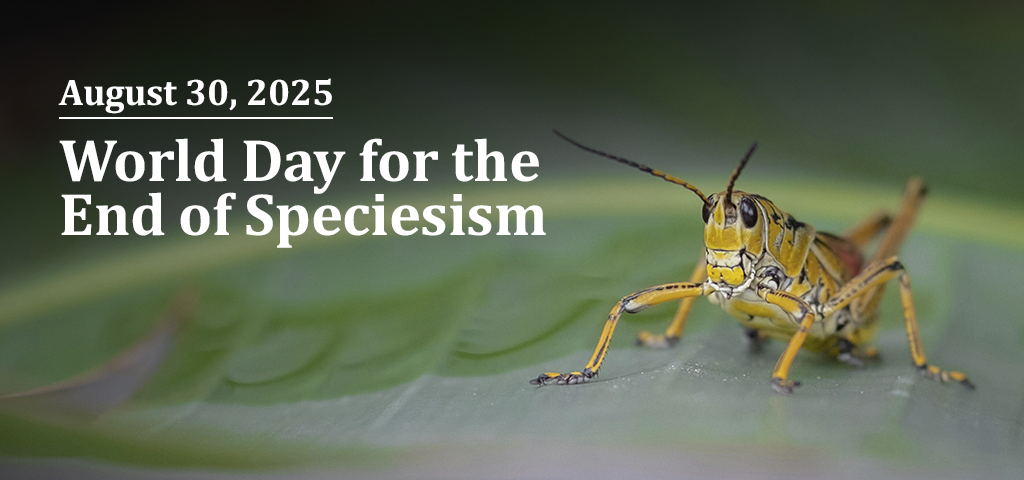
World Day for the End of Speciesism, known as WoDES, is an annual global event that takes place during the last week of August. Its goal is to raise awareness about speciesism.
Organizations from around the world participate in WoDES, each contributing their own unique approach to the fight against speciesism. This year Animal Ethics decided to focus on discussing insect exploitation and related topics.
Have you ever wondered how many insects there are in the world? Are insects sentient? Do we treat them fairly? In this text, we will explore these and other related questions.
Are insects sentient?
What is sentience?
Sentience is the capacity to have experiences, including pleasure, pain, and other sensations. Sentience is what makes a being someone, and it is also what makes them capable of being harmed and benefited.
Scientific evidence
As we will see below, a growing number of studies support sentience in insects. Although many species have yet to be studied (there are millions of them), we have important evidence for insects of various species. Scientists generalize these findings to closely related species. This is already standard procedure regarding the sentience of other animals, including vertebrates and other invertebrates, such as decapod crustaceans.1 That is, if animals of certain species are sentient, then there is good reason to at least give the benefit of the doubt to animals of closely related species in the evolutionary tree.
Here are the main pieces of evidence for insect sentience:
- Organized brains: Insects have centralized nervous systems with distinct brains, which include a region called the protocerebrum with special structures (mushroom bodies) containing between 100,000 and 1 million neurons2
- Intelligent behavior: insects make decisions, learn from previous experiences, and adapt their behavior when situations change3
- Electrical activity: their brains show electrical activity similar to that of other animals known to be sentient4
- Complex neural connections: the wiring map in insect brains resembles that of primates in important ways5
- Information processing: mushroom bodies receive and integrate information from different senses, allowing insects to learn and remember6
Question to consider: if insects show signs of being sentient, how should this change our decisions that affect them?
Insect exploitation
The use of insects has grown significantly in recent years for a variety of purposes:
- Dyeing: Scale insects are killed to make E-120 colorant (carmine red dye)
- Fabrics: silkworms are killed to produce silk
- Honey: bees are exploited to make honey
- Consumption: insects are also consumed directly (sometimes as flour or hamburgers)
- Animal feed: insects are used to make feed for other animals that are also exploited by humans
The numbers are staggering
Let’s look at some sample data:
- Scale insects for dye production: 4.6 to 21 trillion killed per year7
- Insects for food production: 2 to 3.2 trillion killed per year8
- Silkworms: 420 billion to 1 trillion killed per year9
Questions to consider: If these numbers are much higher than, for example, the combined number of exploited mammals and birds, why does almost no one talk about it, not even animal rights activists? Is it because they don’t know? Because they don’t care? For some strategic reason? What could be the causes of this neglect?
How insects are harmed when they are exploited
Poor living conditions
Exploited insects live in even smaller spaces (proportionally to their size) than other exploited animals. 10 Imagine living in a space the size of a closet for their entire lives.
Painful killing methods
Before being killed, insects undergo processes that likely cause great suffering:11
- They are deprived of food for 12 to 24 hours
- They are placed in environments with less oxygen
- They are cooled to temperatures near freezing while still alive
- They are killed by freezing, boiling water, microwaves, ovens, or grinding
Death
Regardless of the suffering, the exploitation of insects harms them because it kills them, depriving them of the positive experiences they could have if they remained alive.12
Important question: If you were an insect, how would you feel about going through these processes? Would you think it was fair to go through this suffering and lose your life so that others could enjoy a few minutes of pleasure? Would it make any morally significant difference that you are small?
Why we should oppose the exploitation of insects
Reason 1: It harms a huge number of individuals
If insects are capable of feeling, so the suffering and deaths of trillions of them is a huge problem. The number of victims is far greater than in many other forms of animal exploitation.
Reason 2: It produces a lot of harm
Humans could choose foods and fabrics that do not involve the exploitation of insects. This shows that insect exploitation is an arbitrary practice, as it disadvantages those who would suffer the greatest harm.13
Reason 3: It violates impartiality
Imagine if you didn’t know whether you would be born a human or an insect. Would you approve of a system where insects are exploited? Probably not, given that there is a possibility that you could be one of them. This shows that those who advocate exploitation do so only because they know they will not be its victims. If so, then this practice fails the impartiality test.14
Responding to some common objections
“Insects feel little pain”
The exploitation of insects is sometimes defended by claiming that animals with less complex brains are less capable of suffering.
First response: Even if they felt little pain, they would still be greatly harmed by their exploitation, as they would suffer and lose their lives.
Second response: In fact, it is possible that insects feel pain quite intensely. The ability to feel pain has prevailed throughout evolutionary history because it is a trait that motivates its bearers to avoid danger.15 Animals with larger brains have other forms of motivation (such as reasoning, for example). But animals with smaller brains depend more on the intensity of pain and pleasure for survival.16 Evolutionary pressure may, therefore, lead to them actually being animals capable of feeling very intensely.
As psychologist Richard D. Ryder observed: “Insects’ experiences may be simpler than ours, but are they less intense? Perhaps the primitive pain a caterpillar feels when crushed is greater than our more sophisticated sufferings”.17
“Death doesn’t harm insects much”
Some people argue that intellectual pleasures are more valuable18 and that, since insects are allegedly incapable of this kind of pleasure, death doesn’t harm them much.
Answer:
Even if it were demonstrated that intellectual pleasures are more valuable (and, by the way, this is also questionable), this doesn’t imply that those incapable of intellectual pleasures are little harmed by death. What would need to be shown to support this conclusion is not that intellectual pleasures are more valuable, but rather that non-intellectual pleasures are almost worthless.
But when we think about our own lives, we realize that simple pleasures (being around loved ones, eating, having sex, having fun, or relaxing) are very important to us. Thus, death can still seriously harm someone by preventing them from experiencing these pleasures, even if they are incapable of intellectual pleasures. This is already widely accepted in the case of humans who, due to congenital conditions, accidents, or illnesses, lack the cognitive capacities typical of other humans.
“What if insects counted less?”
Even if we gave insects less moral weight, that wouldn’t justify exploiting them. Why?
First: Giving someone less weight doesn’t necessarily justify exploiting them. There might be reasons to protect them from exploitation even if someone counted less.
Second: The number of exploited insects is so enormous that even if each one counted much less, we should still give great importance to their plight.19
Example: If each human many more times than each insect, we should still give great importance to the plight of insects because the number of exploited insects is vastly great than the human population.
Note: This doesn’t show that there’s a justification for giving insects less weight. It just shows that, even if there were, it would still be a very important issue. Now, if they should receive equal consideration, then the importance of protecting them is even greater.20
Important conclusions
If all beings that can suffer matter, then insect exploitation is one of the most important problems we face, as the number of victims is simply gigantic.
Final questions:
- Why do you think people often overlook insects?
- What changes could you make in your life to reduce insect suffering?
Notes
1 On this, see Birch, J.; Burn, C.; Schnell, A.; Browning, H. & Crump, A. (2021) Review of the evidence of sentience in cephalopod molluscs and decapod crustaceans, London: The London School of Economics and Political Science, pp. 8-9 [accessed on 13 August 2025].
2 Kaas, J. H. (ed.) (2016) Evolution of nervous systems, Amsterdam: Elsevier.
3 European Food Safety Authority (2005) “Opinion of the Scientific Panel on Animal Health and Welfare (AHAW) on a request from the Commission related to the aspects of the biology and welfare of animals used for experimental and other scientific purposes”, EFSA Journal, 3, 292 [accessed on 13 August 2025]. Mendl, M.; Paul, E. S. & Chittka, L. (2011) “Animal behaviour: Emotion in invertebrates”, Current Biology, 21, pp. R463-R465 [accessed on 7 August 2025]. Adamo, S. A. (2016) “Do insects feel pain? A question at the intersection of animal behaviour, philosophy and robotics”, Animal Behaviour, 118, pp. 75-79.
4 Polilov, A. A. (2012) “The smallest insects evolve anucleate neurons”, Arthropod Structure & Development, 41, pp. 29-34.
5 Kaiser, M. (2015) “Neuroanatomy: Connectome connects fly and mammalian brain networks”, Current Biology, 25, pp. R416-R418 [accessed on 9 August 2025].
6 Gronenberg, W. & López-Riquelme, G. O. (2004) “Multisensory convergence in the mushroom bodies of ants and bees”, Acta Biologica Hungarica, 55, pp. 31-37. Collett, M. & Collett, T. S. (2018) “How does the insect central complex use mushroom body output for steering?”, Current Biology, 28, pp. R733-R734 [accessed on 2 August 2025]. Barron, A. B. & Klein, C. (2016) “What insects can tell us about the origins of consciousness”, Proceedings of the National Academy of Sciences, 113, pp. 4900-4908 [accessed on 13 August 2025]. Klein, C. & Barron, A. B. (2016) “Insects have the capacity for subjective experience”, Animal Sentience: An Interdisciplinary Journal on Animal Feeling, 1 (9) [accessed on 13 August 2025].
7 Rowe, A. (2020) “Global cochineal production: Scale, welfare concerns, and potential interventions”, Effective Altruism Forum, Feb 11 2020 [accessed on 13 August 2025]
8 Rowe, A. (2020) “Insects raised for food and feed — global scale, practices, and policy”, Rethink Priorities [accessed on 13 August 2025].
9 Rowe, A. (2021) “Silk production: Global scale and animal welfare issues”, Rethink Priorities, June, 29 2020 [accessed on 13 August 2025].
10 Animal Ethics (2021) “The use of insects for food”, Animal Ethics [accessed on 14 August 2025].
11 Ibid. International Platform of Insects for Food and Feed (2024) IPIFF guide on good hygiene practices for European Union (EU) producers of insects as food and feed, Brussels: International Platform of Insects for Food and Feed, pp. 57-78 [accessed on 1 August 2025].
12 A detailed analysis of the harm caused by the killing of nonhuman animals can be found in Cunha, L. C. (2025) “Os animais e o dano da morte: uma investigação sobre o dano da morte e sua magnitude”, Senciência e ética: perguntas e respostas [accessed on 13 August 2025].
13 For an explanation of the principle underlying this reasoning, see Singer, P. (2011 [1993]) Practical ethics, 3rd ed., Cambridge: Cambridge University Press, pp. 90-93; Cunha, L. C. (2021) Uma breve introdução à ética animal, Curitiba: Appris, pp. 61-66.
14 Rowlands, M. (2009 [1998]) Animal rights: Moral, theory and practice, 2nd ed., New York: Palgrave Macmillan, pp. 118-175.
15 On this subject (but using decapods as an example), see Gherardi, F. (2009) “Behavioural indicators of pain in crustacean decapods”, Annali dell´Istituto Superiore di Sanita, 45, pp. 432-438.
16 About this, see Animal Ethics (2021) “The development of sentience in juvenile animals”, Animal Ethics, 15 Sep 2021 [accessed on 14 August 2025].
17 Ryder, R. (2002) Painism: A modern morality, London: Open Gate, p. 64.
18 See, for example: Mill, J. S. (1985 [1861]) Essays on ethics, religion, and society, London: Routledge and Kegan Paul, ch. 2 [accessed on 18 August 2025]. See also Singer, P. (2011 [1993]) Practical ethics, op. cit., ch. 3.
19 About this argument, see Vinding M. (2019) “On insects and lexicality”, Magnus Vinding, August 27 [accessed on 13 August 2025].
20 For a detailed discussion of the importance of this issue, see Cunha L. C. (2023) “A situação dos insetos: o quão importante é essa questão?”, Revista de Filosofia Aurora, 35 [accessed on 13 August 2025].