Animal Ethics: 2026 Annual Report
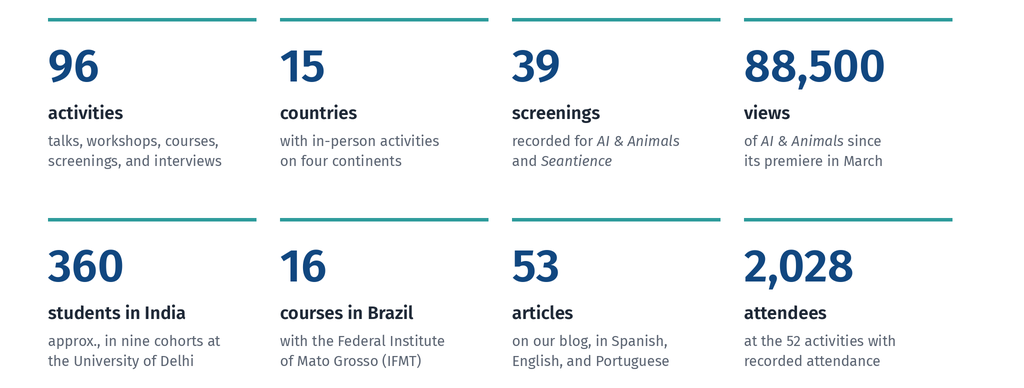
In 2026, we ran 96 activities in 15 countries and premiered our documentary AI & Animals, which has already reached 88,500 views. We also published a report on the sentience of decapod crustaceans and a new section on invertebrates on our website, and we brought animal ethics into university classrooms in India and Brazil.
Animal Ethics is an international nonprofit working against speciesism. We focus on those who receive the least attention: animals living in the wild, aquatic animals, invertebrates, and the sentient beings of the future, whose fate is increasingly being shaped by the development of artificial intelligence.
Our website is available in 13 languages, and all our documentaries, reports, and texts are free to access. This report summarizes what we achieved in 2026 thanks to our supporters, and what we want to do in 2027 if we secure the funding we need.
This Giving Tuesday, double your impact: until January 7, 2027, an anonymous donor will match every donation, up to a total of $10,000. Donate now.
2026 in numbers
Documentaries about the most overlooked animals
AI & Animals and Seantience were screened at least 39 times in 2026, in 14 countries and online. Many of these screenings were co-organized with local groups, universities, and other organizations. The real number is likely higher, because not every group that hosts a screening lets us know.
For many organizations, our documentaries are a way to open a conversation with their audiences, often followed by a discussion. This year they were screened by groups such as Sinergia Animal, Animal Save Movement, and the Centre for a Responsible Future, as well as the Centre for Animal Ethics at Pompeu Fabra University and effective altruism groups in Sweden, Canada, Mexico, and Hungary.
| Documentary | Released | About | Languages | Screenings in 2026 |
|---|---|---|---|---|
| AI & Animals | March 2026 | How AI affects animals | English; Spanish and French subtitles; Chinese, Japanese, and Hindi subtitles coming soon | 22 |
| Seantience | October 2025 | The sentience of aquatic animals | English and Spanish; Portuguese, Chinese, and Catalan subtitles | 17 |
AI & Animals: a strong response from audiences and organizations
AI & Animals premiered on March 1 and has already reached 88,500 views. In its first two months, it passed 9,400 organic views, helped by platforms such as UnchainedTV and Plant Based News. Directed by Alba García Bernal and Oscar Horta, it features 16 experts, including Peter Singer, Jonathan Birch, and Jeff Sebo.
Peter Singer shared it with his followers and joined Constance Li and Animal Ethics member Aditya S. Karanam for a discussion on UnchainedTV. The documentary has been screened at events such as EAGx Sweden, EAGx Washington DC, and the AVA Summit Canada, and at universities in Barcelona and Santiago de Compostela (Spain), Pécs (Hungary), and Victoria (Canada), as well as the Indian Institute of Technology Madras. Organizations such as Sentient Futures, Electric Sheep, and the Center for Reducing Suffering use it in their courses and training programs, as does our own fellowship in India.
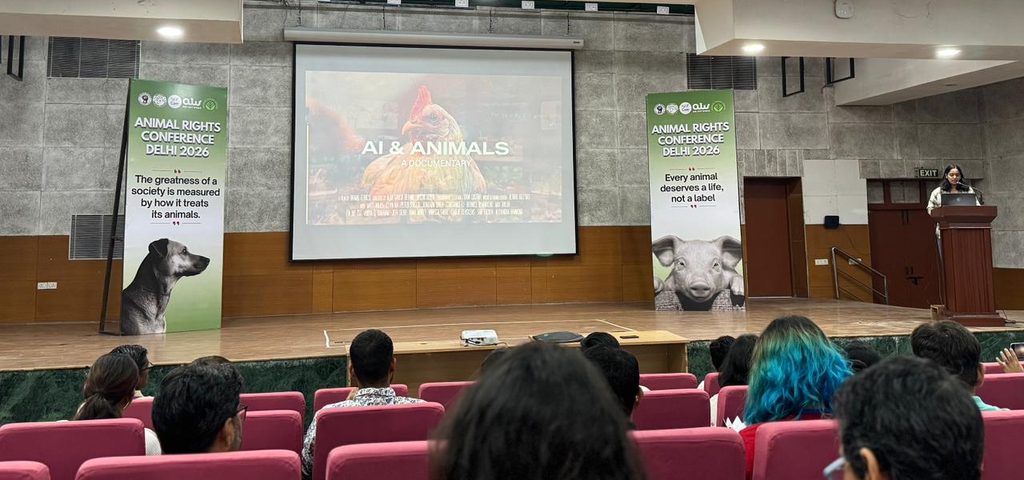
Screening of AI & Animals at the Animal Rights Conference Delhi 2026.
Seantience: awards and new languages
Seantience, our documentary on the sentience of aquatic animals, won two awards and was an official selection at four festivals in 2026, and now has Portuguese, Chinese, and Catalan subtitles.
| Festival | Year | Recognition |
|---|---|---|
| FAUNA Tepoztlán Animal Festival | 2026 | Winner, Domingo Award for the Most Just Cause |
| S.O.F.A. Film Festival | 2026 | Best Short 2026 |
| Neum Underwater Film Festival | 2026 | Official selection and semifinalist |
| Vegan Çiftlik Short Film Festival | 2026 | Official selection |
| Arctic Film Festival | 2026 | Official selection |
| My Name Is Climate Film Festival | 2026 | Official selection |
| Festival Internacional de Cine Animal y Ambiental (FICAA) | 2025 | Best Cinematography |
| SUNCINE | 2025 | Official selection |
| FAUNA Tepoztlán Animal Festival | 2025 | Official selection |
Since its release in October 2025, it has been screened at least 23 times, 17 of them in 2026. Without any paid social media promotion, it has reached more than 10,000 organic views. This year, screenings took it to Argentina, Canada, Chile, Ecuador, India, Latvia, Mexico, Spain, and the United States. In India, it was screened alongside a Q&A with Jonathan Birch at Sadhana Forest (Auroville).
Next: two documentaries on wild animal suffering
In October, together with the University of the Basque Country, we released La otra cara de la naturaleza (“The other side of nature”), a short pilot documentary on why it matters to help animals living in the wild. Funded by the Spanish government, it has already reached over 23,000 views and has been screened in Spain and, with Portuguese subtitles, in Brazil.
Building on this pilot, in 2027 we plan to produce two films for an international audience: a new English-language version of the documentary The other side of nature and a second documentary for academic audiences, featuring wild animal welfare experts from around the world. With them, we want to reach scientists and conservationists who are open to considering the welfare of individual wild animals.
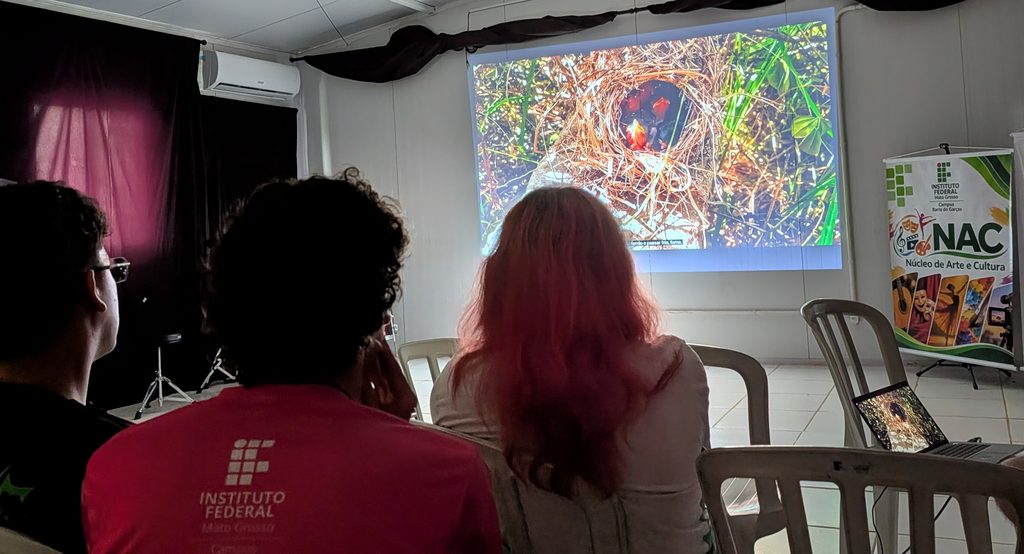
Screening at the Federal Institute of Mato Grosso, Brazil.
The pilot is part of a broader project that also produced three reports and a practical guide (in Spanish) to help public authorities and professionals protect wild animals in cities and during wildfires, floods, and heat waves.
Training the people who will shape animals’ future
India: our fellowship at the University of Delhi
The year began with a series of talks on wild animal welfare at seven colleges of the University of Delhi in January and February, to promote our Hindi-language course on wild animal suffering. The contacts we made with faculty and students led to the Animal Ethics India Fellowship, one of the first animal ethics training programs at Indian universities.
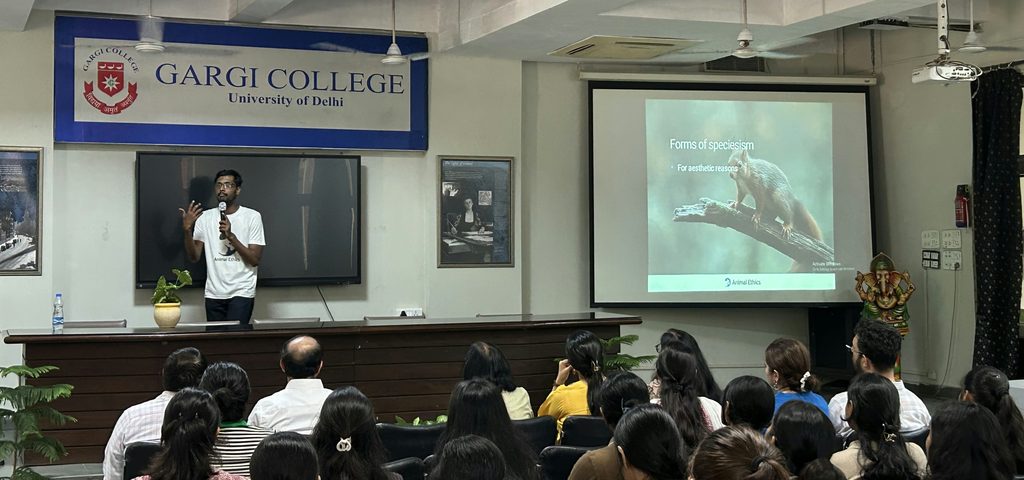
Talk on speciesism at Gargi College, University of Delhi.
The fellowship trains students to advocate for all sentient beings, with a special focus on the most neglected animals. Around 360 students took part in nine cohorts in 2026, and a tenth cohort is confirmed to start in January.
In total, we held 34 activities in India in 2026, with at least 1,233 attendees. Most were talks at 18 colleges of the University of Delhi, and we also spoke at a few other institutions, such as the Indian Institute of Technology Madras and Dr. B.R. Ambedkar University Delhi, as well as at animal advocacy events.
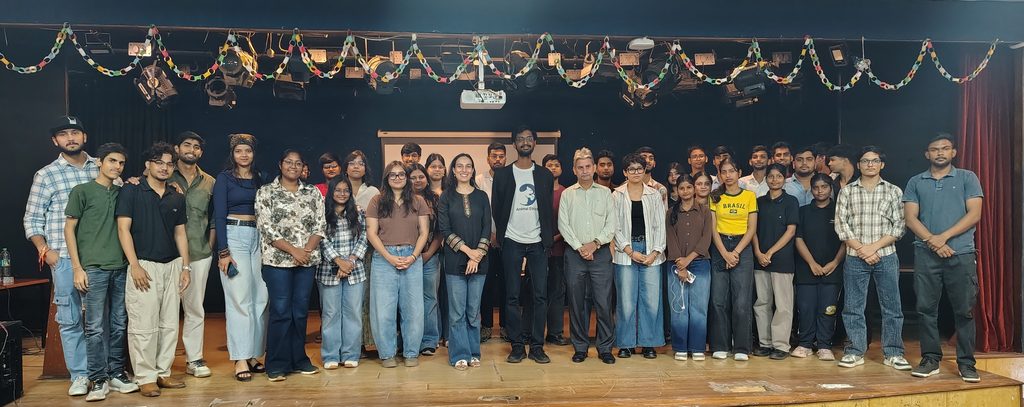
Students at Dyal Singh College, University of Delhi, with the Paws & Tails society.
Brazil: 16 courses with the Federal Institute of Mato Grosso
This year, we offered 16 free online courses, eight per semester, open to students of the Federal Institute of Mato Grosso (IFMT), who can earn academic credits, and to the general public. Our work with Brazilian universities began in 2019: since then, we have taught 41 courses with more than 10,000 enrollments.
In the first semester of 2026, the courses received 1,041 enrollments, and 249 people completed them. The most popular was Foundations of animal ethics. Other topics included the situation of wild animals, the long-term future, and effective advocacy.
Talks and events on four continents
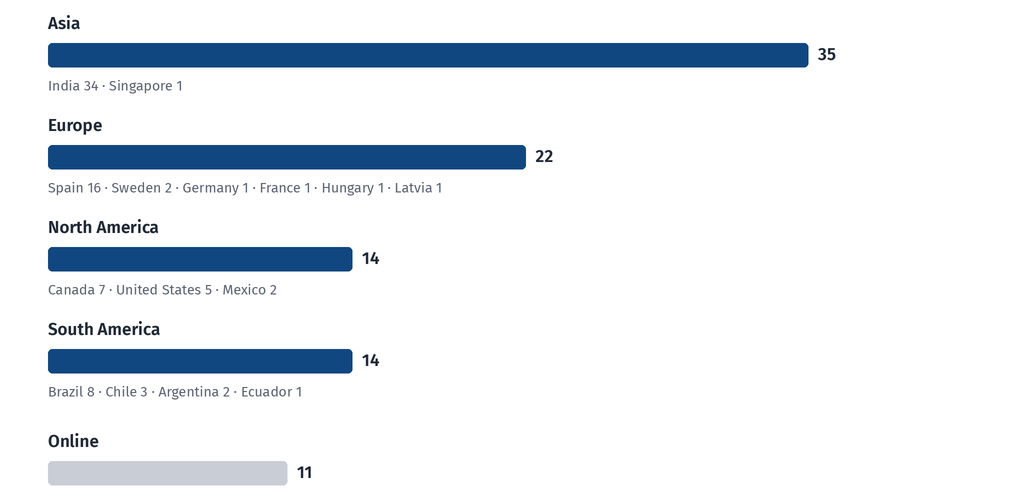
Our 96 activities in 2026 reached 15 countries on four continents, as well as online audiences. Asia and Europe accounted for more than half of them, mainly because of our work in India and Spain.
Shao Ran’s first European tour
For years, Shao Ran worked as a cetacean trainer in China, one of the countries where the number of dolphinariums and aquariums has grown the most. After seeing the suffering of the animals she worked with, such as the beluga Sophie, she left that job and devoted herself to defending them, giving talks across the country. Today she is one of the best-known voices in Chinese animal advocacy, and her videos and interviews have been viewed more than 100 million times.
In February and March, we brought Shao Ran to Europe for the first time. We co-organized her talks in Spain: at the University of Santiago de Compostela, at a secondary school in Boiro, and in Madrid, attended by around 80 people. Other organizations also invited her to speak in Barcelona, Munich, and Paris.
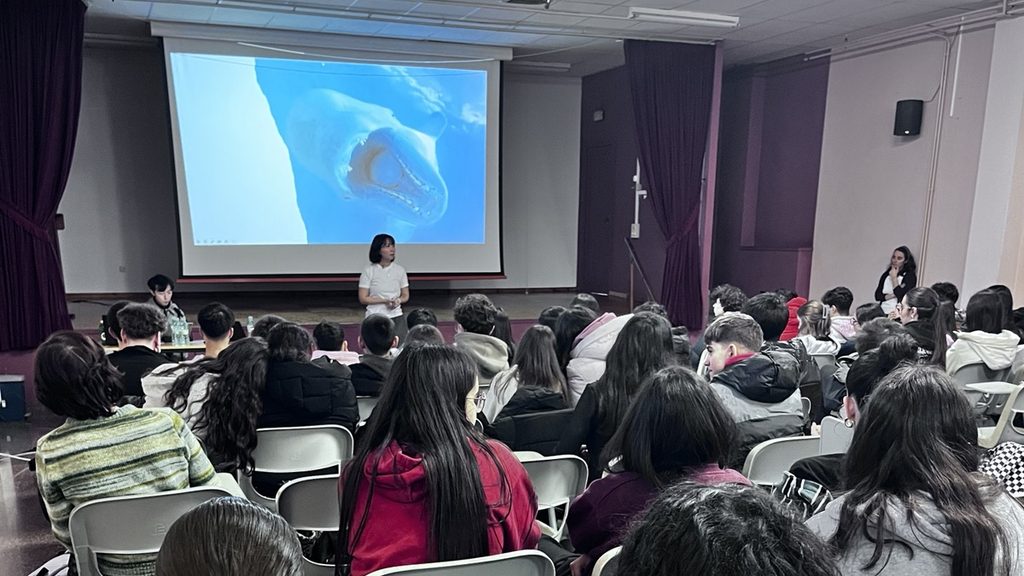
Shao Ran speaking during her European tour.
But aquariums are only part of the picture: China is also one of the world’s largest producers of farmed fishes and invertebrates. That is why cooperation with Chinese animal advocates matters so much: to learn from their experience and, where we can, to support their advocacy in a country of more than 1.4 billion people.
Before the end of the year, we will publish a video about Shao Ran and her story.
Highlighted conferences and events
- EAGx Sweden (Stockholm): talk on AI and animals for around 60 people
- Animal Rights Lab (Toronto): talk and panel on AI and animals, attended by around 60 people
- AVA Summit Canada: screening of AI & Animals and a talk on the challenge AI poses for billions of sentient beings
- India Animal Welfare Summit (Mumbai) and Ultra Impact for Animals Summit (Bengaluru): presentations of our work and our fellowship to organizations and funders
- University of Santiago de Compostela: talk on AI, animal ethics, and political philosophy, and a co-organized seminar on AI and wild animal welfare
- In the media: a conversation with Peter Singer on UnchainedTV, Oscar Horta’s appearance on the Animal Law Research Group podcast, and an interview on a British radio channel
Two world days for the most exploited animals
On two major antispeciesist days of the year, we focused on the most numerous and most neglected animals: aquatic animals and invertebrates.
March 28: World Day for the End of Fishing and Fish Farming
Every year, tens of trillions of aquatic animals are killed, including fishes, crustaceans, and cephalopods, caught in seas and rivers or raised in aquatic farms. For the 10th edition of this day, we prepared content in three languages:
- In English, an interview with Mart Gross, professor emeritus of biology at the University of Toronto and one of the experts featured in Seantience
- A report on the sentience of decapod crustaceans (crabs, lobsters, shrimps, and others) that brings together the latest scientific evidence and its ethical implications, which we published in Spanish and English
- In Portuguese, a live presentation of the same report on YouTube and its translated version
August 29: World Day for the End of Speciesism
For this day, we published a new section on invertebrates on our website, with 15 texts in five categories: exploitation, scientific evidence of sentience, in-depth reports, scientific and institutional recognition, and methodological tools.
The data show that in the main forms of exploitation, between 14 and 24 times more invertebrates than vertebrates are killed every year. Mammals and birds, who receive the most attention, make up less than 0.25% of the total. Even so, invertebrates are the animals we know least about, with the least legal protection and the fewest advocates.
Published blogs: 53 articles in three languages
In 2026, we published 53 articles on our blog: 19 in English, 16 in Spanish, and 18 in Portuguese. Two or three more will be out before the end of the year, plus a piece onDecember 10 for theInternational Animal Rights Day.
These were the main themes of the year:
- AI and digital sentience: why current language models should align with the consideration of all sentient beings, why digital sentience matters, and what OpenAI’s new Model Spec says about animals
- Animals living in the wild: rewilding in the United Kingdom and how wild animals are affected by wars and natural disasters
- Aquatic animals and invertebrates: progress and gaps in the legal protection of octopuses, and our report on the sentience of decapod crustaceans
- Advocacy strategy: how to decide which problems deserve priority, how to influence different audiences, and different approaches to animal advocacy
- Arguments and progress: the objection that eating animals is “natural” and the ban on producing and selling foie gras in Brazil
What we want to achieve in 2027
Our budget for 2027 is $270,000, and we still need to secure $220,000.
These are the five projects we want to work on next year, and for which we are seeking support:
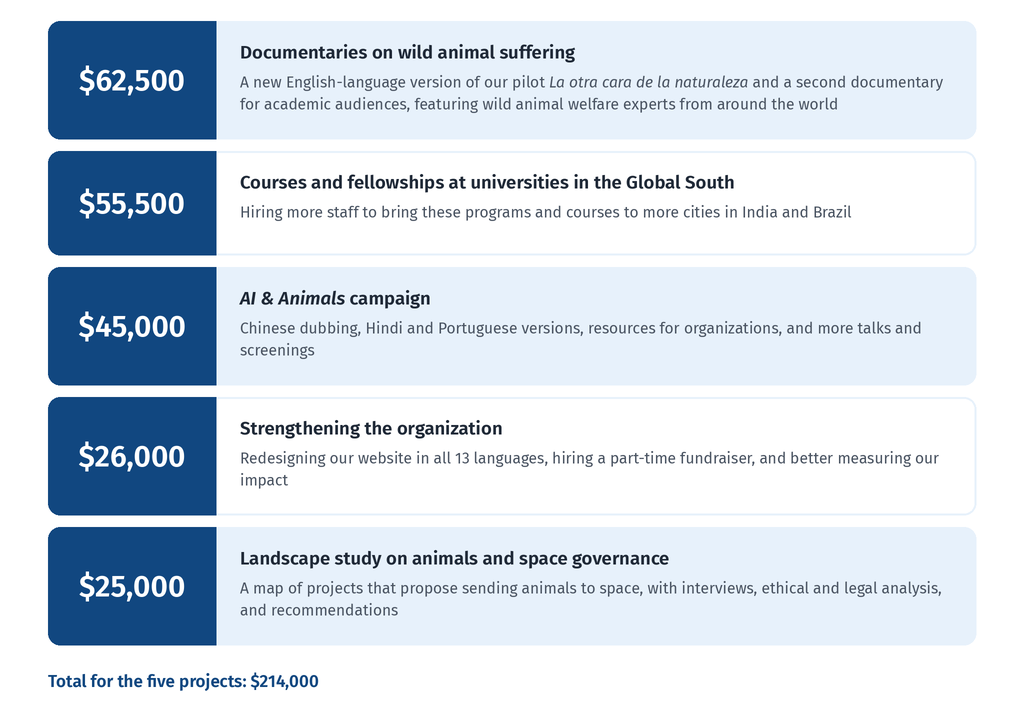
The minimum we need to raise to keep operating is $120,000.
The landscape study on animals and space governance responds to a new risk: as space technology and AI advance, there is growing interest in sending animals to space, either to use them for food in settlements or to spread life to other planets. Today, there is almost no accessible, organized information about this risk.
Part of the 2027 work is already underway: IFMT has asked to renew our partnership for university courses, and the tenth cohort of our fellowship at the University of Delhi starts in January.
How you can help
Donate this Giving Tuesday, or any time before January 7, 2027, and an anonymous donor will match your gift, up to a total of $10,000. Your donation will go twice as far.
We need to raise at least $120,000 to keep working in 2027, and $220,000 to fund our full plan. Every donation counts.
Above all, we are asking for your help with two goals:
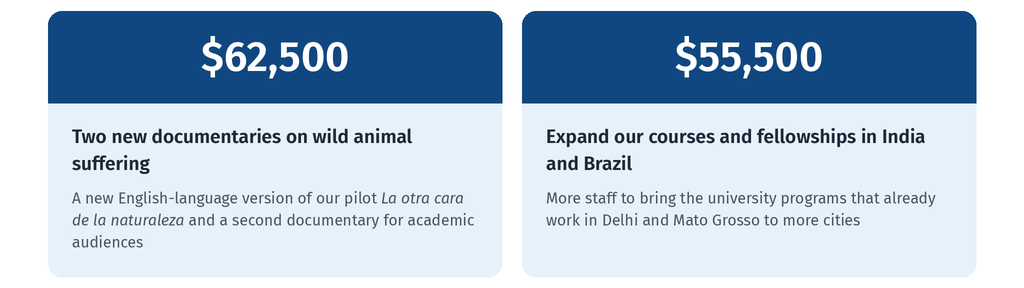
Your donation brings the defense of the most neglected animals to classrooms, events, and organizations where they are still rarely discussed.
- Donate on our donation page
- If you represent a foundation or would like to make a major gift, email us at [email protected]
- Share this post on social media
Thank you for making a year like this possible. With you, we can go even further in 2027.
The Animal Ethics team