The exploitation of invertebrates in numbers
Invertebrate animals are the overwhelming majority of animals exploited by humans, yet they almost never appear in the statistics. The charts below bring together the available estimates of how many individuals are killed each year worldwide in the largest-scale forms of exploitation.
These estimates vary widely, in some cases by a factor greater than four between the minimum and the maximum value. The reason is telling: most of these animals are counted not individually, but by weight.
Mammals and birds, who receive almost all of the public attention and most of the advocacy efforts, form the smallest column in the chart: they account for less than 0.25% of the total, that is, fewer than one in every 400 animals killed. The two tallest columns correspond to animals who are rarely mentioned: cochineal insects, killed to produce a dye, and shrimps caught at sea. It is also worth highlighting the 462 billion to 1.1 trillion aquatic animals who die not to be eaten by humans, but to feed other animals raised in captivity.
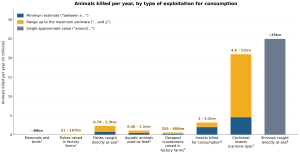
Includes the cochineal insect, used as a food coloring (carmine, also listed on labels as cochineal extract) in yogurts, juices, cured meats, candy, and cosmetics.
The following chart compares the total number of vertebrates and invertebrates killed in these forms of exploitation:
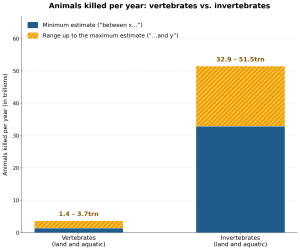
Aggregates the same sources indicated in charts 1 and 3.
Between 14 and 24 times more invertebrates than vertebrates are killed each year. The difference holds even in the most conservative comparison possible: the minimum estimate for invertebrates is still almost nine times higher than the maximum estimate for vertebrates. In other words, around 19 out of every 20 animals killed in these forms of exploitation are invertebrates, and they are precisely the ones about whom there is the least data, the least legislation, and the least advocacy work.
The following chart presents data on the most exploited invertebrate animals:
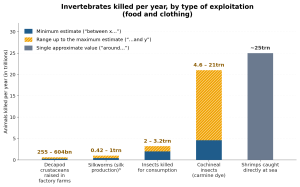
The references for the other categories are the ones given in the first chart.
Two forms of exploitation account for around 90% of that total: the production of carmine dye and shrimp fishing. The case of silkworms also deserves attention: silk production alone kills between five and twelve times more animals each year than all the mammals and birds killed for food. They are small animals, but the size of an individual says nothing about their capacity to suffer.
Finally, it is important to remember that these figures cover only direct exploitation for food and clothing. They do not include the bees exploited in beekeeping: there is no global estimate of how many die each year as a result of that exploitation. Nor do they include the invertebrates killed by insecticides or those who live in the wild, whose populations are orders of magnitude larger than any of the figures presented here.
Notes
1 Our World in Data (2018) “Number of animals slaughtered for meat, World, 1961 to 2018”, Our World in Data [accessed on 24 August 2026]; Sanders, B. (2018) “Global animal slaughter statistics and charts”, Faunalytics, October 10 [accessed on 24 August 2026].
2 Fishcount (2019) “Fishcount estimates of numbers of individuals killed in (FAO) reported fishery production”, Fishcount: Reducing Suffering in fisheries [accessed on 24 August 2026].
3 Fishcount, Ibid.
4 Fishcount, Ibid.
5 Fishcount, Ibid.
6 Rowe, A. (2020) “Insects raised for food and feed — global scale, practices, and policy”, Rethink Priorities, June 29 [accessed on 24 August 2026].
7 Rowe, A. (2020) “Global cochineal production: scale, welfare concerns, and potential interventions”, Effective Altruism Forum, February 11 [accessed on 24 August 2026].
8 Waldhorn, D. & Autric, E. (2023) “Shrimp: The animals most commonly used and killed for food production”, Rethink Priorities, August 11 [accessed on 24 August 2026].
9 Rowe, A. (2021) “Silk production: global scale and animal welfare issues”, Rethink Priorities, April 19 [accessed on 24 August 2026].