How wild animals are treated in global emergencies (wars and natural disasters)
Any emergency, whether a war, pandemic, or natural disaster, disrupts the lives of those who experience it. Every affected community involves several sentient beings who respond differently to such disruption. Today, countries face complex emergencies with multiple overlapping crises at once. Yet, when we study these global emergencies, we mainly focus on human experiences. Wild animals, who are equally a sentient part of these disruptive systems, are often ignored. So, while the scale of their suffering is large, it remains largely absent from reports. In fact, we lack even the basic tools to assess or respond to the impact on wild animals.
This tendency to ignore the fate of nonhuman sentient beings limits our understanding of animal suffering, especially when both human action and inaction lie at its roots.
Natural disasters and their impact on wild animals
Why do we look away from animals during natural disasters?
People tend to look away from the suffering of animals during disasters because they:
·⠀Regard nonhuman animals as having less moral worth than humans and therefore give less weight to their suffering
·⠀Maintain that we should not intervene in the outcomes of harmful natural processes, yet they hold this position only when the victims are non-human animals (a reverence for the natural subordinated to anthropocentric speciesism)
·⠀Perceive large numbers of animals as species rather than as individual lives lost
·⠀Notice only the survivors, remaining oblivious to the immense, unseen loss of other sentient beings, often due to a lack of information about their deaths
·⠀Assume that animals, being closer to nature, are naturally equipped to handle such disasters better than humans
What one should rather consider:
·⠀Assigning less moral weight to nonhuman animals is speciesism, a form of discrimination
·⠀All sentient beings capable of experiencing harm have an interest in avoiding it. If two sentient beings can experience injury, fear, or distress, the mere fact that one belongs to a different species does not, by itself, justify giving less moral weight to its interests. This reveals an inconsistency in ethical reasoning.
·⠀Ethical principles should be applied consistently across sentient beings. If higher rationality, intelligence, or other cognitive abilities do not justify giving unequal moral consideration among humans, they cannot serve as the basis for treating non-human animals as morally irrelevant and inferior.
·⠀Likewise, the cause of suffering does not change the experience of the individual undergoing it. Natural disasters are harmful. Regardless of their origin, they result in immense suffering. Thus, if the reason for avoiding harm is that it is detrimental to its victims, then the strength of those reasons must depend on the magnitude of the harm, rather than on whether its origin is anthropogenic or natural.
·⠀Continued exposure to natural threats doesn’t make wild animals ‘stronger’ or immune to harm. On the contrary, repeated exposure to disease, starvation, extreme weather conditions, and other stressors is more likely to compromise their welfare.
·⠀Humans have survival instincts, yet many still die in disasters, even with help and resources. Wild animals face even bigger risks, as they have no shelters or support. Survival instinct, at its best, is merely a reactive force to a perceived threat.
·⠀Human-made barriers, shrinking habitats, and the specific needs of many species make migration very difficult. Some animals, such as pandas and reptiles, cannot move quickly or survive outside their native environments. Even when they do move, they may face conflict or death in new areas. Moreover, animals in the wild may be very young and therefore particularly vulnerable during disasters due to their limited ability to flee or survive on their own.
Ways in which natural disasters impact wild animals:
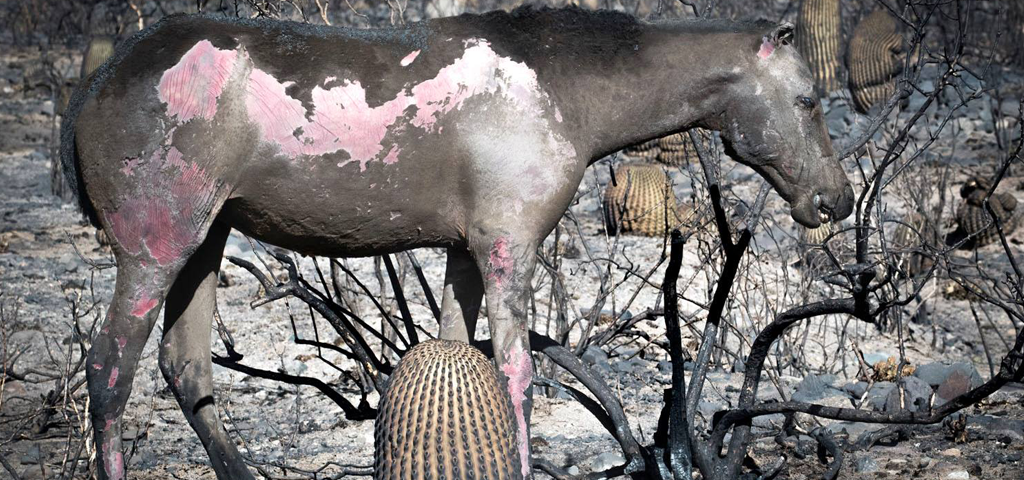
·⠀Direct harm: Since wild animals live in constant and immediate contact with nature, they are the first to suffer direct physical harm, including drowning during floods, being buried under rubble in landslides or earthquakes, suffering severe burns during wildfires, or getting caught in lava flows during volcanic eruptions. The scale of such harm is intense.
During the 2020 Pantanal wildfires in Brazil, researchers estimated that at least 16.95 million vertebrates were killed immediately by the fires.1 Note that the number of dead invertebrates was likely much higher, given that they are far more numerous. However, since invertebrates typically receive even less consideration than vertebrates, there are no statistics regarding their deaths. More animals likely lost their lives, particularly due to smoke exposure. During volcanic eruptions and wildfires, smoke usually travels far beyond the source, causing harmful effects over a much larger area. Smoke inhalation can cause carbon monoxide poisoning, respiratory distress, neurological impairment, oxidative stress, respiratory and cardiovascular disease, immunosuppression, and pulmonary edema in terrestrial and aquatic wild animals, many of which can be fatal.2
The same pattern repeated in 2026, on two continents at once. In Spain, two fires burning in the provinces of Ávila, Madrid and Toledo merged in late July into a single blaze. By 28 July it had scorched more than 80,000 hectares, and the cumulative area burned across the country stood at 173,651 hectares. In Canada, more than 900 wildfires were burning simultaneously by mid-July, from British Columbia to Nova Scotia, with 2.78 million hectares already lost, a total that had stood at less than half the ten-year average only ten days earlier.
For neither event does any estimate of wild animal deaths exist. Six years after researchers used distance sampling to establish that nearly 17 million vertebrates died in the Pantanal fires, no comparable count has been attempted for the Iberian Peninsula or for the Canadian boreal forest. The absence of a number is not evidence that the deaths did not occur. It reflects the fact that nobody has been given the task of counting them. Burned protected areas are reported in hectares; the animals who lived in those hectares are reported as habitat.
·⠀Resource scarcity: The survival of wild animals relies on essential resources such as food, water, shelter, and a suitable habitat. Natural disasters can diminish both the availability and accessibility of these resources. Eruptions can last for months or years, spewing abrasive and toxic lava and ash, causing explosions, and heating nearby water that can boil marine animals alive.3 Earthquakes and hurricanes cause fragmentation, making it harder for animals to move or survive. Floods and tsunamis often bring harmful chemicals, while droughts dry up wetlands and reduce water sources. Without shelter, clean water, or enough food, many animals face dehydration and starvation.
For instance, the 2020 bushfires that razed more than 11.2 million hectares in Australia damaged about 30% of koala habitats, Eucalypt Woodlands, which they use for both food and shelter.4 Many koalas, unable to escape the flames, died of burns. Others survived, only to suffer days of thirst and hunger.
·⠀Migration & breeding: Climate-related disasters like heatwaves, droughts, and storms are harming the places where birds breed and migrate.
Take, for instance, the case of Arctic geese in the Siberian tundra. They depend on open, rocky ground to lay their eggs, build nests, and raise their offspring. But rising temperatures are melting the frozen soil, allowing forests to spread across the land. Experts estimate that anywhere between 10 to 93% of their breeding territory will be lost in the next few years if expansion continues.5 Because nests protect against predators and unsuitable environmental conditions, their absence exposes these birds to threats and distress, thereby causing more suffering.
·⠀Increased human-wild animal conflict: Human-wild animal conflict is any interaction between wild animals and humans that causes harm, whether it is to the human or the wild animal.6 Natural disasters make this conflict worse.
·⠀Animals come into human-dominated areas to flee the destruction
·⠀With no food in the wild, they eat crops or attack farm animals
·⠀Hungry, hurt, or scared animals may act more aggressively
·⠀After disasters, people often rebuild homes in forest areas, leading to more encounters
An example of how such conflicts can be addressed can be found in Kerala, an Indian state where wild animals such as elephants, gaur (Indian bison), wild boars, tigers, leopards, and monkeys often come into conflict with people. The government has officially declared “human-wildlife conflict a state disaster”.7 To tackle the situation, it has brought its own programs instead of relying on retaliatory killings of wild animals, a practice that is common in many other countries despite being cruel and ineffective. These include an SMS alert system that provides a warning of elephant and other wild animal movements, and programs ensuring the availability of water and food within the forest for animals to discourage them from entering human habitations.8 These practices have reduced the incidence of such conflicts.
·⠀Long-term changes: Long-term changes are impacts that last for months or even years after a disaster. These include polluted water sources, increased salinity, and other environmental changes that may reduce the availability of food and shelter, or otherwise affect the well-being of wild animals.
Wars and their impact on wild animals
When humans fight, animals suffer too.9
For the past three years, an average of more than 20 countries have experienced a serious conflict every month.10 History has, from time to time, revealed the devastating impact of wars, yet we often fail to recognize the harm they inflict beyond the human world.
Animals often become victims of war. Many are killed directly through weapons, while others slowly suffer and die from hunger, injury, and the loss of other essential resources necessary for survival. More often than not, they are exploited as soldiers or resources in human conflicts, with their capacity to experience pain, fear, and distress given little to no moral weight.
Warfare, besides traditional weapons, now includes:
·⠀Biological weapons: spread pathogens to wild animals, enable cross-species disease transmission, cause long-term genetic change, and affect food availability and habitat quality negatively
·⠀Nuclear weapons: cause large-scale harm to wild animals through firestorms or blast, genetic mutation, radiation poisoning, and much more
·⠀Chemical weapons: animals are poisoned by inhaling toxic gases, absorbing chemicals through their skin, or consuming contaminated food and water
The emergence of biological, nuclear, and chemical weapons has transformed the nature of warfare by expanding both the scale and duration of harm. Since their effects can spread across individuals of several species and persist long after active conflicts cease, we remain uncertain of their impact. As a result, a potentially vast amount of suffering will continue to occur beyond our awareness unless sustained attention and resources are devoted to studying their impact on wild animals and ways to alleviate the harm.
Nevertheless, existing evidence provides compelling reasons to believe that warfare has inflicted extensive suffering on wild animals. Take, for instance, Agent Orange, a chemical herbicide, which was heavily used during the Vietnam War. More than fifty years later, we still know little about its full impact on wild animals. Available evidence suggests that aquatic invertebrates, such as stoneflies (Plecoptera), caddisflies (Trichoptera), mayflies (Ephemeroptera), and water fleas (Cladocera), were among the most vulnerable to exposure.11 There is no research detailing exactly how Agent Orange affected these insects, but contact with contaminated soil and water likely led to the death of these living, sentient beings.
Conclusion
Global emergencies like natural disasters and wars are among the most significant sources of disruption in terms of the scale (the number of individuals affected), magnitude (the severity of the harm), and duration (how long those harms persist) of their impact across species. As discussed, wild animals experience numerous forms of suffering during and after such events, including immediate harms, indirect harms, and long-term harms. Despite the extent of their suffering, their welfare remains inadequately considered during disaster management.
In every crisis, we protect what we believe matters most. But our view is shaped by biases like speciesism and anthropocentrism. These biases narrow our vision by overlooking the interests of countless sentient beings capable of experiencing harm, fear, distress, and deprivation. If emergencies are understood as events that disrupt the lives of sentient beings, then our assessment of their effects cannot end with human experiences alone. Therefore, it becomes essential to consider the welfare of wild animals in disaster preparedness, response, and recovery, especially when intervention can prevent or alleviate their suffering.
Notes
1 Tomas, W. M.; Berlinck, C. N.; Chiaravalloti, R. M.; Faggioni, G. P.; Strüssmann, C.; Libonati, R.; Abrahão, C. R.; Alvarenga, G. do V.; Faria Bacellar, A. E. de; Queiroz Batista, F. R. de; Bornato, T. S.; Restel Camilo, A.; Castedo, J.; Espinóza Fernando, A. M.; Oliveira de Freitas, G.; Martins Garcia, C.; Santos Gonçalves, H.; Freitas Guilherme, M. B. de; Guedes Layme, V. M.; Gomes Lustosa, A. P.; Carneiro de Oliveira, A.; Oliveira, M. da R.; Martins Pereira, A. de M.; Abrantes Rodrigues, J.; Fernandes Semedo, T. B.; Ducel de Souza, R. A.; Rodrigo Tortato, F.; Passos Viana, D. F.; Vicente-Silva, L. & Morato, R. (2021) “Distance sampling surveys reveal 17 million vertebrates directly killed by the 2020’s wildfires in the Pantanal, Brazil”, Scientific Reports, 11, 23547 [accessed on 15 July 2026].
2 Sanderfoot, O. V.; Bassing, S. B.; Brusa, J. L.; Emmet, R. L.; Gillman, S. J.; Swift, K. & Gardner, B. (2021) “A review of the effects of wildfire smoke on the health and behavior of wildlife”, Environmental Research Letters, 16, 123003 [accessed on 12 July 2026].
3 Animal Ethics (2021) “Animals in natural disasters”, Animal Ethics [accessed on 15 July 2026].
4 Paul, S. (2020) “‘Ecological disaster’: Australian bushfires endanger koalas, wallabies”, Science, The Wire, 13/01/2020 [accessed on 15 July 2026].
5 Wood, S. (2023) “How climate change is affecting migrating birds”, Birdbuddy Tales, February 27 [accessed on 15 July 2026].
6 Ramachandra, K.; Bakash, S. A. & Nagabhushana, S. (2018) Ability enhancement, Nagpur: Himalaya, ch. 2.
7 Saseendran, A K. (2025) “From conflict to coexistence: Rethinking our survival with wildlife”, Arnayam, 45 (4), p. 6 [accessed on 15 July 2026].
8 Saseendran, A K. (2025) “From conflict to coexistence: Rethinking our survival with wildlife”, op. cit., p. 7
9 The Economist (2018) “How war affects wildlife”, The Economist, Jan 11th 2018 [accessed on 15 July 2026].
10 Institute for Economics & Peace (2025) Global Peace Index 2025, Sydney: Institute for Economics & Peace [accessed on 15 July 2026].
11 Truong, K. N. & Khuong V. D. (2021) “Agent Orange: Half-century effects on the Vietnamese wildlife have been ignored”, Environmental Science & Technology, 55, pp. 15007-15009 [accessed on 15 July 2026].