The legal protection of octopuses and what it leaves out
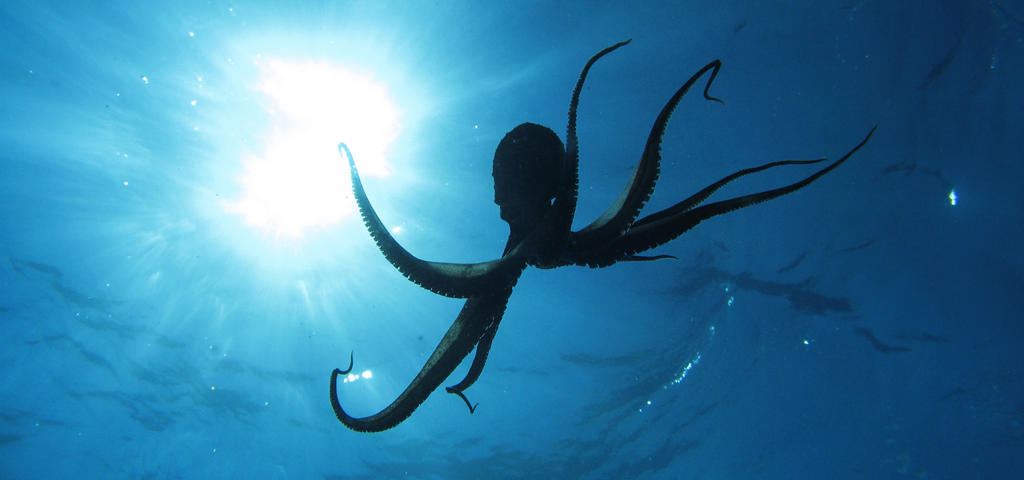
Few animals arouse as much curiosity as octopuses. The law, however, barely recognizes them. They are invertebrates, and that alone was enough to leave them, for decades, outside the reach of protective legislation and, to a large extent, outside public concern as well. That has begun to change: scientific research over the past two decades has transformed what we know about their capacities, and the prospect of raising them on industrial farms has opened a legislative debate that now spans several continents. In this article, we examine what the evidence shows about octopus sentience, how octopuses are harmed by human exploitation, what their lives in the wild are like, what their legal situation is, and what reasons we have to change all of this.
Octopuses are sentient
A report commissioned by the government of the United Kingdom,1 published in November 2021 and produced by a team of scientists at the London School of Economics, reviewed more than 300 studies on sentience in two groups of invertebrates: cephalopod mollusks (octopuses, squids, cuttlefishes, and nautiluses) and decapod crustaceans (crabs, lobsters, and shrimps). The report used eight criteria (listed below) to assess the evidence of sentience, and it graded its level of confidence that the animals in question satisfy or fail each criterion as follows:
·⠀(VH) Very high: when there is a large amount of reliable, high-quality evidence, leaving no room for reasonable doubt
·⠀(H) High: when the team is convinced, even though some room for reasonable doubt remains
·⠀(M) Medium: when concerns about the reliability of the evidence prevent high confidence
·⠀(L) Low: little evidence that an animal satisfies or fails the criterion
·⠀(VL) Very low: when the evidence is seriously inadequate or nonexistent
Of all the taxa the report analyzed, octopuses (order Octopoda) gathered the strongest evidence:
·⠀Possession of nociceptors: VH
·⠀Possession of integrative brain regions: VH
·⠀Connections between nociceptors and integrative brain regions: H
·⠀Responses affected by potential local anesthetics or analgesics: H
·⠀Motivational trade-offs that show a balancing of threat against opportunity for reward: M
·⠀Flexible self-protective behaviors in response to injury and threat: VH
·⠀Associative learning that goes beyond habituation and sensitization: VH
·⠀Behavior that shows the animal values local anesthetics or analgesics when injured: H
It is worth clarifying that medium or low confidence does not mean the animal fails to satisfy the criterion, only that the available evidence is still scarce or not very robust. That is the reason for the M on motivational trade-offs: no studies test this point directly in octopuses.
Under the report’s grading scheme, high or very high confidence that seven or eight criteria are satisfied amounts to very strong evidence of sentience. Octopuses satisfy seven criteria with high or very high confidence, and so the report concludes that there is very strong evidence of their sentience, the highest assessment among all the taxa it examined. Its central recommendation, however, is that all cephalopods and all decapods be recognized as sentient animals, rather than only the most-studied groups.
Two important declarations by the scientific community on animal sentience also recognize octopus sentience explicitly.
The Cambridge Declaration on Consciousness,2 published on July 7, 2012, states:
“The weight of evidence indicates that humans are not unique in possessing the neurological substrates that generate consciousness. Nonhuman animals, including all mammals and birds, and many other creatures, including octopuses, also possess these neurological substrates.”
The New York Declaration on Animal Consciousness,3 in turn, explicitly includes cephalopod mollusks among the animals for whom there is a realistic possibility of conscious experience, alongside all vertebrates and many other invertebrates. The declaration adds that when such a realistic possibility exists, it is irresponsible to ignore it in decisions that affect these animals.
The exploitation of octopuses
Humans exploit octopuses for a range of purposes, the main one being food. Government reports contain no count of the individuals who are killed, because fisheries measure landings in tons. According to data from the FAO (Food and Agriculture Organization of the United Nations), annual global octopus catches range from roughly 350,000 to 500,000 metric tons per year.4 The average weight of a captured octopus falls between 700 grams and 2 kilograms, or about 1.5 to 4.4 pounds.5 On that basis, estimates suggest that fisheries kill between 250 million and 500 million octopuses every year. 6
Octopuses are also exploited in scientific research, where they serve as models for neurobiology, cognition, and robotics because of their decentralized nervous system.7 In addition, they are used for conservation purposes in public aquariums and, in private aquariums, for display.8
How octopuses suffer when they are exploited
The harms that exploitation causes octopuses occur at different stages:
·⠀Capture. Hooks, traps, and trawl nets tear the octopuses’s sensitive skin, which has neither scales nor a protective shell, and they slowly asphyxiate out of the water.9
·⠀Slaughter. Traditional methods include direct immersion in ice, in which octopuses die slowly from thermal shock and asphyxiation; mechanical piercing of the brain without prior anesthesia (brain spiking); decapitation; and beating against rocks. There are no standardized methods, internationally recognized as painless, for industrial scale.10
·⠀Handling in captivity and aquaculture. Octopuses are solitary and highly territorial. In densely crowded confinement or in aquariums without environmental enrichment, they suffer anxiety, boredom, bodily injuries, aggressive behaviors, cannibalism, and self-mutilation.11
·⠀Live consumption. In some places, people eat octopuses while they are still alive,12 or cut them into pieces immediately before eating them.
What octopuses’ lives are like in the wild
Octopuses are not subject only to the harms humans cause them. Their life cycles are naturally very short. Beyond that, the vast majority of octopuses who are born do not die of old age. Quite the opposite: they die before reaching adulthood. We can infer this from the number of eggs in each spawning, as we explain below.
How many offspring octopuses produce varies considerably from one species to another, but in the species that fisheries exploit most it is enormous: a common octopus (Octopus vulgaris) lays between 100,000 and 500,000 eggs in her single spawning, and each hatchling emerges just a few millimeters long.13 That fact alone indicates that the vast majority die very young. Over periods of relative population stability across several generations, we can estimate the average early mortality rate from the number of offspring: if the population holds steady, that means that, on average, only one offspring per parent survives to adulthood and takes that parent’s place in the following generation. All the rest die before that.14
The legal situation of octopuses
The legal situation of octopuses is an unusual case in public policy, because in most territories the industry that legislation seeks to regulate does not yet exist on a commercial scale. Here we review the state of that legislation, along with the specific rules underpinning it, focusing on the European Union, the United States and Latin America.
The starting point: legal recognition of sentience
The first legal text that partly broke with the exclusion octopuses had suffered in the European Union was Directive 2010/63/EU of the European Parliament and of the Council, of September 22, 2010, on the protection of animals used for scientific purposes. Its recital (8) states the following: “In addition to vertebrate animals including cyclostomes, cephalopods should also be included in the scope of this Directive, as there is scientific evidence of their ability to experience pain, suffering, distress and lasting harm.“15
That protection, however, is strictly confined to scientific experimentation. It is this gap that has fueled the development and introduction of legislative initiatives in several European countries.
Outside the scientific sphere, the European legal framework on animal welfare in food production rests on general rules that formally apply to aquaculture but were not designed with cephalopods in mind:
·⠀Council Directive 98/58/EC, of July 20, 1998, concerning the protection of animals kept for farming purposes, sets minimum standards for all animals raised for food production, including fishes, reptiles, and amphibians. According to EFSA, it constitutes the minimum legal basis for protecting the aquatic species exploited in the European Union.16
·⠀Council Regulation (EC) No 1099/2009, of September 24, 2009, on the protection of animals at the time of killing, regulates that stage, although its effective application to aquatic species remains limited.17
·⠀European aquaculture policy has its legal basis in the 2013 Common Fisheries Policy (Regulation (EU) No 1380/2013), whose Article 34 promotes sustainable aquaculture through an open method of coordination among member states, again without addressing welfare provisions specific to octopuses.18
None of these rules expressly cover cephalopod farming, which has led several organizations to petition the European institutions directly to fill that gap. Specifically, they have asked the European Commission to include a ban on octopus farming in its Vision 2040 for fisheries and aquaculture,19 arguing that keeping this species in captivity for production is incompatible with the recognition of animals as sentient beings enshrined in Article 13 of the Treaty on the Functioning of the European Union. That recognition has a longer history than people usually assume: it began with a non-binding declaration annexed to the Maastricht Treaty in 1992, acquired legal force with the Protocol on the protection and welfare of animals annexed to the Treaty of Amsterdam in 1997, and took its current form, in Article 13, with the Treaty of Lisbon, in force since 2009.20
Spain concentrates much of the European debate, largely because of the attempt by the company Nueva Pescanova to install what would have been the world’s first industrial octopus farm at the Port of Las Palmas de Gran Canaria, with a planned capacity of 3,000 metric tons a year, the equivalent of around one million octopuses annually.21 On the legislative front, two parliamentary groups have registered Proposición de Ley 122/000202 in the Congress of Deputies, seeking to prohibit intensive industrial octopus farming in Spain by invoking the precautionary principle.22
Part of the opposition to the project came from a public that, a few years earlier, had come to know octopuses in a new way. On September 7, 2020, Netflix released the documentary My Octopus Teacher, which follows the relationship between filmmaker Craig Foster and a wild octopus in a kelp forest off the coast of South Africa over the course of a year. The film won the Oscar for Best Documentary Feature in April 2021, along with the BAFTA and the Producers Guild of America award in the same category, and it appeared repeatedly among Netflix’s ten most-watched titles in several countries.23 The documentary presented an octopus as someone with a biography of her own, with curiosity, fear, and preferences, rather than as a fishery resource. Pippa Ehrlich, who co-directed the film, reported receiving thousands of messages from viewers saying they would never eat octopus again.24 It is plausible that this shift in perception helped make opening the world’s first industrial octopus farm politically costly.
In July 2026, Nueva Pescanova finally abandoned its Gran Canaria project, citing business and regulatory reasons after new requirements from the Canary Islands Regional Environmental Assessment Commission.25 That withdrawal, however, does not amount to a ban on octopus farming, and there may well be another attempt to open a farm of this kind in the future. Research into octopus farming does in fact continue in Spain: in January 2025, the Xunta de Galicia authorized Octolarvae, a subsidiary of Grupo Profand, to set up an experimental common octopus hatchery in Moaña devoted to larval rearing, in collaboration with the CSIC.26
The United States: the first wave of state bans
Unlike the European Union and Spain, where the debate remains at the proposal stage, the United States already has state laws in force. Washington State led the way: House Bill 1153, known as the Washington octopus protection law, was signed in March 2024 and took effect on June 6 of that year.27 It was the first state ban on octopus farming in the United States, and several organizations and media outlets described it as the first in the world.28 The law prohibits octopus aquaculture in the state, although, unlike the later Californian rule, it does not prohibit selling octopuses from farms outside the state.
California followed suit with Assembly Bill 3162, known as the California Oppose Cruelty to Octopuses (OCTO) Act, signed on September 27, 2024, and in force since January 1, 2025, when both the farming ban and the sales ban took effect. With it, California became the second state to prohibit octopus farming and the first to prohibit selling octopuses raised in captivity as well. The law establishes, in its new Section 15007.5 of the Fish and Game Code, that it is unlawful to engage in the aquaculture of any octopus species for human consumption, and that no business owner or operator may sell, possess, or transport any octopus that is the result or product of aquaculture. The rule nevertheless continues to permit octopus fishing with a license, with a daily limit of 35 individuals per person.29
The momentum has not stopped on the West Coast. In Hawaii, legislators introduced a similar bill, HB 2262, in January 2024, and it stalled in committee when the legislative session ended. At the federal level, Senators Sheldon Whitehouse and Lisa Murkowski introduced bill S.4810 in July 2024, known as the OCTOPUS Act, which sought to extend the ban on octopus farming and on the marketing of octopus products to the entire country. The bill died when that Congress ended, and it was reintroduced in June 2025 as S.1947.30
Latin America: legislating before the industry exists
The most singular cases are Mexico and Chile, where lawmakers are acting on a strictly preventive basis, with no consolidated commercial industry yet in existence. In February 2026, a bill reached the Mexican Senate to reform the Ley General de Pesca y Acuacultura Sustentables (General Law on Sustainable Fisheries and Aquaculture), aiming to prevent the breeding, pre-fattening, and fattening of any cephalopod species in the country, and to deny concessions or permits for installing farms devoted to these species.31
One of the proposal’s central arguments draws on data from the facility in Sisal, Yucatán, which is the only one in the Americas that raises octopuses and sells octopus meat. It is not an industrial farm: it is a UNAM research unit that raises the Maya octopus (Octopus maya) and sells the result through an agreement with the local cooperative Moluscos del Mayab. After more than a decade of operation, the facility records a mortality rate of 52%, with around 30% of those deaths attributed to cannibalism caused by confinement.32 The head of the Instituto Mexicano de Investigación en Pesca y Acuacultura Sustentables responded publicly to these criticisms, arguing that every farming operation involves some degree of cannibalism and mortality, and that this does not make the activity unviable.33
A legal vacuum that remains the norm
Despite this legislative momentum, the general situation is still, above all, one of regulatory emptiness. Only in a few jurisdictions, such as Washington and California, is a ban in force. The other initiatives described here, from the Spanish one to the Mexican one, are still making their way through the process without having become law. Meanwhile, the aquaculture of individuals of other marine species (fishes, crustaceans, and bivalve mollusks) keeps expanding34 without any comparable protective framework, and the interests of these animals remain outside legal consideration.
The debate about octopuses is valuable above all because it makes visible something that usually goes unnoticed: the vast majority of sentient animals on the planet are invertebrates, and they remain without any significant legal protection, whether in animal farming and fishing or in their natural habitat. That legislation is beginning to recognize their capacity to suffer is an important step. But as long as that protection is limited to particular species and to very specific contexts, such as the industrial aquaculture of a single species, the vast majority of invertebrate animals will remain outside any legal consideration.
Why we should change the situation of octopuses
As we have seen, octopuses are sentient beings: they are someone for whom things can go better or worse. That is exactly why they should receive moral consideration. It is also, incidentally, the same reason humans, or any other sentient animal, should receive moral consideration.
But if octopuses should receive moral consideration, that is, if their good matters for its own sake, then we have reasons to defend them from events that harm them. We have seen that they are gravely harmed not only by their exploitation, but also by the way natural processes unfold. So, besides having reasons to fight their exploitation, we also have reasons to research how to reduce the rates of premature mortality that natural processes bring about. These reasons exist, of course, not only in the case of octopuses, but in that of any sentient being.
Notes
1 Birch, J.; Burn, C.; Schnell, A.; Browning, H. & Crump, A. (2021) Review of the evidence of sentience in cephalopod molluscs and decapod crustaceans, London: London School of Economics and Political Science [accessed on August 30, 2026].
2 Low, P.; Panksepp, J.; Reiss, D.; Edelman, D.; Van Swinderen, B. & Koch, C. (2012) “The Cambridge declaration on consciousness“, Animal Ethics [accessed on August 30, 2026].
3 Andrews, K. et al. (2024) “The New York declaration on animal consciousness“, The New York Declaration on Animal Consciousness, April 19 [accessed on August 30, 2026].
4 Food and Agriculture Organization of the United Nations (2026) “Cephalopods“, FAO GLOBEFISH [accessed on August 30, 2026]. Lara, E. (2021) Octopus factory farming: A recipe for disaster, Surrey: Compassion in World Farming International [accessed on August 30, 2026].
5 The range corresponds to the landing weights most commonly documented. Lara, E. (2021) Octopus factory farming: A recipe for disaster, op. cit.
6 Lara, E. (2021) Octopus factory farming: A recipe for disaster, op. cit. Jacquet, J.; Franks, B. & Godfrey-Smith, P. (2019) “The octopus mind and the argument against farming it“, Animal Sentience, 4 (26), p. 1 [accessed on August 30, 2026].
7 O’Brien, C. E.; Roumbedakis, K. & Winkelmann, I. E. (2018) “The current state of cephalopod science and perspectives on the most critical challenges ahead from three early-career researchers“, Frontiers in Physiology, 9, 700 [accessed on August 30, 2026]. Graziano, G.; Affuso, A.; Basil, J.; Cole, A.; Girolamo, P. de; D’Angelo, L.; Dickel, L.; Gestal, C.; Grasso, F.; Kuba, M.; Mark, F.; Melillo, D.; Osorio, D.; Perkins, K.; Ponte, P.; Shashar, N.; Smith, D.; Smith, J.; Andrews, P. L. R. (2015) “Guidelines for the care and welfare of cephalopods in research – A consensus based on an initiative by CephRes, FELASA and the Boyd Group“, Laboratory Animals, 49 (2 suppl.), pp. 1-90 [accessed on August 30, 2026]. Laschi, C.; Cianchetti, M.; Mazzolai, B.; Margheri, L.; Follador, M. & Dario, P. (2012) “Soft robot arm inspired by the octopus”, Advanced Robotics, 26, pp. 709-727.
8 Jacquet, J.; Franks, B. & Godfrey-Smith, P. (2019) “The octopus mind and the argument against farming it”, op. cit., p. 2. Lara, E. (2021) Octopus factory farming: A recipe for disaster, op. cit.
9 Birch, J.; Burn, C.; Schnell, A.; Browning, H. & Crump, A. (2021) Review of the evidence of sentience in cephalopod molluscs and decapod crustaceans, op. cit., pp. 60-61.
10 Ibid., pp. 63-64. Lara, E. (2021) Octopus factory farming: A recipe for disaster, op. cit.
11 Jacquet, J.; Franks, B. & Godfrey-Smith, P. (2019) “The octopus mind and the argument against farming it”, op. cit., p. 2. Lara, E. (2021) Octopus factory farming: A recipe for disaster, op. cit.
12 Lara, E. (2021) Octopus factory farming: A recipe for disaster, op. cit., p. 33.
13 Norman, M. D.; Finn, J. K. & Hochberg, F. G. (2014) “Family Octopodidae”, in Jereb, P.; Roper, C. F. E.; Norman, M. D. & Finn, J. K. (eds.) Cephalopods of the world: An annotated and illustrated catalogue of cephalopod species known to date: Volume 3. Octopods and vampire squids, Rome: Food and Agriculture Organization of the United Nations, pp. 43-44 [accessed on August 30, 2026].
14 Horta, O. (2010) “Debunking the idyllic view of natural processes: Population dynamics and suffering in the wild“, Télos, 17, pp. 73-88 [accessed on August 30, 2026].
15 European Parliament & Council of the European Union (2010) “Directive 2010/63/EU of the European Parliament and of the Council of 22 September 2010 on the protection of animals used for scientific purposes“, Official Journal of the European Union, 20.10.2010, pp. L 276/33 – L 276/79 [accessed on September 1, 2026].
16 Council of the European Union (1998) “Council Directive 98/58/EC of 20 July 1998 concerning the protection of animals kept for farming purposes“, Official Journal of the European Communities, 08/08/1998, pp. 23-27 [accessed on September 1, 2026]. European Food Safety Authority (2023) “Fish welfare“, EFSA [accessed on September 1, 2026].
17 Council of the European Union (2009) “Council Regulation (EC) No 1099/2009 of 24 September 2009 on the protection of animals at the time of killing“, Official Journal of the European Union, 18/11/2009, pp. 1-30 [accessed on September 1, 2026].
18 European Parliament & Council of the European Union (2013) “Regulation (EU) No 1380/2013 of the European Parliament and of the Council of 11 December 2013 on the Common Fisheries Policy, amending Council Regulations (EC) No 1954/2003 and (EC) No 1224/2009 and repealing Council Regulations (EC) No 2371/2002 and (EC) No 639/2004 and Council Decision 2004/585/EC“, Official Journal of the European Union, L 354, 28.12.2013, pp. L 354/22 – L 354/60 [accessed on September 1, 2026].
19 European Commission, Directorate-General for Maritime Affairs and Fisheries (2026) “Commission seeks feedback on the future of the fisheries and aquaculture sector“, Oceans and fisheries, 24 February 2026 [accessed on September 1, 2026].
20 European Union (1992) “Declaration on the protection of animals“, Official Journal, 29/07/1992, p. 103 [accessed on September 1, 2026]; (1997) “Treaty of Amsterdam amending the Treaty on European Union, the Treaties establishing the European Communities and certain related acts – Protocol annexed to the Treaty of the European Community – Protocol on the application of the principles of subsidiarity and proportionality“, Official Journal, 10/11/1997, p. 105 [accessed on September 1, 2026]; (2016) “Consolidated versions of the Treaty on European Union and the Treaty on the Functioning of the European Union“, art. 13, Official Journal of the European Union, 7.6.2016 [accessed on September 1, 2026].
21 Compassion in World Farming (2023) “Cruel and unsustainable octopus farm must be scrapped“, Compassion in World Farming, March [accessed on August 30, 2026].
22 Grupo Parlamentario Plurinacional SUMAR & Grupo Parlamentario Mixto (2025) “Proposición de Ley sobre la prohibición de la acuicultura con pulpos en España (122/000202)“, Congreso de los Diputados, 20/06/2025 [accessed on August 30, 2026].
23 Thompson, A. (2021) “‘My Octopus Teacher’ will win the best documentary Oscar — Here’s why“, IndieWire, April 7 [accessed on August 30, 2026]. Carey, M. (2021) “Netflix wins second straight best documentary feature Oscar with ‘My Octopus Teacher‘”, Deadline, April 25 [accessed on August 30, 2026].
24 Inquirer.net (2021) “‘My Octopus Teacher’: Human-octopus love story up for best documentary Oscar“, Inquirer.net, April 20 [accessed on September 1, 2026].
25 Canarias Ahora (2026) “Pescanova retira su petición para crear una granja de pulpos en el Puerto de Las Palmas“, Canarias Ahora, July 23, 2026 [accessed on September 1, 2026].
26 Xunta de Galicia (2025) “La Xunta destaca la planta de cultivo larvario y acuicultura regenerativa de Octolarvae en Moaña que sitúa a Galicia a la vanguardia en investigación marina“, Consellería do Mar, September 18, 2025 [accessed on September 1, 2026]. The activity permit, published in the Diario Oficial de Galicia in January 2025, was granted for a renewable period of 10 years: Fernández Díaz, S. (2026) “Profand se lanza ahora a la aventura de criar pulpos tras los intentos de Pereira, Nissui en Japón y Nueva Pescanova“, Canarias7, 31/08/2026 [accessed on September 1, 2026].
27 Washington State Legislature (2024) “House Bill 1153: Octopus aquaculture, Chapter 45, Laws of 2024“, Washington State Legislature, June 6 [accessed on September 1, 2026]. Washington State Legislature (2024) “HB 1153 – 2023-24“, Washington State Legislature [accessed on September 1, 2026].
28 Aquatic Life Institute (2024) “Washington State prohibits octopus farming: A major victory for animals“, Aquatic Life Institute [accessed on September 1, 2026].
29 California Legislature (2024) “AB 3162: Octopus: aquaculture: prohibition“, California Legislative Information, 9/27/24 [accessed on September 1, 2026]. Animal Legal Defense Fund (2024) “Octopus farming ban (California)“, Animal Legal Defense Fund [accessed on August 30, 2026].
30 Hawai’i State Legislature (2024) “HB 2262“, Hawai’i State Legislature [accessed on September 1, 2026]. United States Congress (2024) “S.4810: OCTOPUS Act of 2024“, Congress.gov, 7/25/2024 [accessed on September 1, 2026]. Whitehouse, S. (2025) “Ahead of World Ocean Day, Whitehouse and Murkowski reintroduce bipartisan legislation to ban commercial octopus farming“, Sheldon Whitehouse, June 5 [accessed on August 30, 2026].
31 Proceso (2026) “Por qué México busca prohibir las granjas de pulpos antes de que exista la industria“, Proceso, 11/3/2026 [accessed on August 30, 2026]. This refers to Bill 17913-12, introduced in the Chilean Chamber of Deputies in October 2025. 2000Agro (2026) “Proyecto de ley busca prohibir la cría de pulpos a nivel federal en México”, 2000Agro, mar 6 [accessed on August 30, 2026].
32 The data are based on anecdotal reports from the farm itself, on work published by the UNAM research center in Sisal, and on various interviews available in the media. Aquatic Life Institute (2024) “What lies behind Mexico’s octopus farm research facade?” “, Aquatic Life Institute [accessed on August 30, 2026].
33 Vargas, A. (2025) “¿Son viables las granjas de pulpo en Sisal? El IMIPAS responde”, Posta, December 08 [accessed on August 30, 2026].
34 Food and Agriculture Organization of the United Nations (2024) The state of world fisheries and aquaculture 2024: Blue transformation in action, Rome: FAO [accessed on August 30, 2026].