The most exploited animals in the world: A new section on invertebrates for World Day for the End of Speciesism
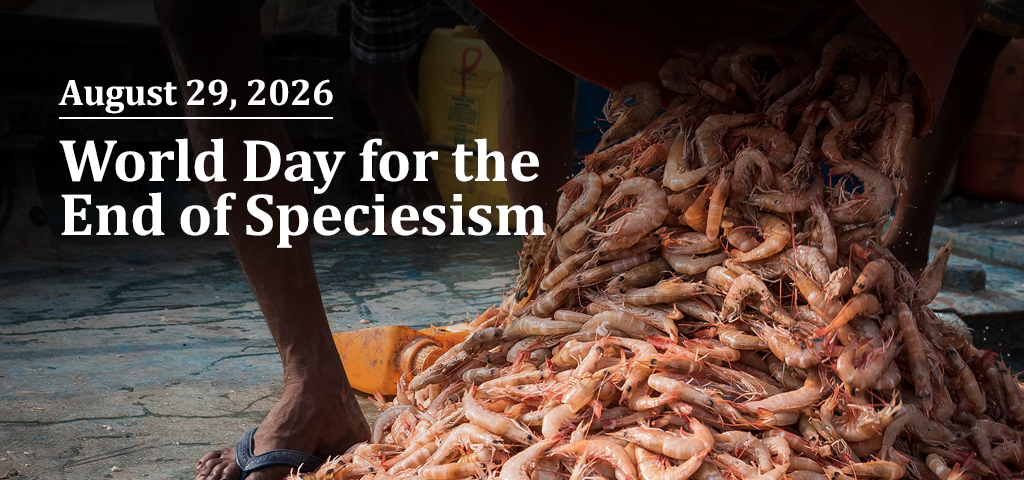
World Day for the End of Speciesism (WoDES) is an annual global event. This year it takes place on August 29. On this date, animal advocacy groups around the world come together to protest against speciesism, comparing it to other forms of discrimination, such as racism and sexism.
For this edition, we at Animal Ethics have decided to highlight the situation of invertebrates, who make up the overwhelming majority of animals, both among those exploited by humans and among those living in the wild. These animals also generally receive even less consideration than other animals. Animal advocacy reproduces this pattern as well: invertebrates are mentioned far less often, despite their numbers.
A new section on our website dedicated to invertebrates
Given the urgency of this issue, we have just published a new section on our website, dedicated to invertebrate animals. In this section you will find 15 texts that address a wide range of questions concerning this group of animals.
The section is divided into five categories, briefly described below:
·⠀Exploitation of invertebrate animals
Contains five articles describing how humans harm invertebrate animals by exploiting them in various sectors, and presenting figures on the number of invertebrates exploited.
·⠀The scientific evidence for sentience
Contains six articles presenting the data that support the recognition of sentience across a wide range of invertebrates.
·⠀Articles on invertebrate animals
Contains two comprehensive studies, one on the sentience of aquatic animals and another on decapod crustaceans. These studies examine scientific aspects and ethical questions concerning these animals, and assess the best ways to help them.
·⠀Scientific and institutional recognition
Contains two articles on the official recognition of invertebrate sentience by the scientific community.
·⠀Methodological tools
Contains one article presenting tools that make it possible to estimate invertebrate animal populations and, by extension, the magnitude of their suffering.
→ Visit the new section: Invertebrate animals
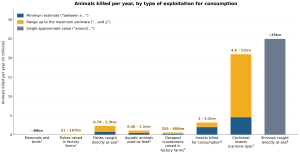
The new section includes the topic “The exploitation of invertebrates in numbers”, which shows the scale of this exploitation compared with that of other animals. There you will find charts such as the following, which compare the number of individuals humans kill each year worldwide in the main forms of exploitation.
Support us
Your help allows us to carry on this work and, through it, to make sure the situation of these animals receives the attention it deserves. Click here to donate now!
Notes
1 Our World in Data (2018) “Number of animals slaughtered for meat, World, 1961 to 2018”, Our World in Data [acessado em 24 de agosto de 2026]; Sanders, B. (2018) “Global animal slaughter statistics and charts”, Faunalytics, 10 de outubro [accessed on 24 August 2026]
2 fishcount.org.uk (2019) “Fishcount estimates of numbers of individuals killed in (FAO) reported fishery production”, fishcount.org.uk [accessed on 24 August 2026].
3 Ibid.
4 Ibid.
5 Ibid.
6 Rowe, A. (2020) “Insects raised for food and feed — global scale, practices, and policy”, Rethink Priorities, June, 29 2020 [accessed on 24 August 2026].
7 Rowe, A. (2020) “Global cochineal production: scale, welfare concerns, and potential interventions”, Effective Altruism Forum, Feb 11 [accessed on 24 August 2026].
8 Waldhorn, D. & Autric, E. (2023) “Shrimp: The animals most commonly used and killed for food production”, Rethink Priorities, September 8 [accessed on 24 August 2026].